


 |
 |
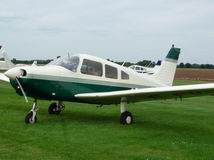
PA28 Warrior II |
PA28 Warrior II Instrument panel |
General
The PPL(A) is a non-expiring “lifetime” licence. Once issued the licence is held unless it is provisionally suspended, suspended or revoked by the issuing authority or is surrendered by the holder
However, for the licence to be valid for any particular flight the medical certificate, relevant aircraft ratings and certificates must be valid
Applicants for a PPL(A) shall be at least 17 years of age. A student pilot for a PPL(A) shall be at least 16 years of age before first solo flight
Applicants for a PPL(A) shall complete a training course at a DTO or ATO
Licence Issue and Experience Requirements
Applicants for a PPL(A) shall have completed:
(a) The UK CAA Flight Training (UK CAA AMC1 FCL.210 PPL(A) Training course) or EASA Flight Training (EASA AMC1 FCL.210 PPL(A) Training course) as applicable
(b) The (UK CAA and EASA) Theoretical Knowledge Training (AMC1 FCL.210; FCL.215 Training course and theoretical knowledge examination)
(c) The (UK CAA and EASA) Theoretical Knowledge Examination (FCL.215 Theoretical knowledge examination | FCL.025 Theoretical knowledge examinations for the issue of licences and ratings)
(d) Part Med.A.030 states that a Class 2 medical certificate is required for the initial application of a PPL(A)
(e) FCL.055 Language proficiency states an aeroplane, helicopter, powered-lift and airship pilots required to use the radio telephone shall not exercise the privileges of their licences and ratings unless they have a language proficiency endorsement on their licence in either English or the language used for radio communications involved in the flight. The Operational Level (Level 4) is the minimum required proficiency level for radiotelephony communication
UK CAA Flight Training (UK CAA AMC1 FCL.210 PPL(A) Training course)
The student pilot for a PPL(A) shall obtain an appropriate medical certificate at least before their solo flight e.g. Class 2
(a) Applicants for a PPL(A) shall have completed at least 45 hours of flight instruction in aeroplanes or TMGs, 5 of which may have been completed in an FSTD, including at least:
(1) 25 hours of dual flight instruction and
(2) 10 hours of supervised solo flight time, including at least 5 hours of solo cross-country flight time with at least 1 cross-country flight of at least 270 km (150 NM), during which full stop landings at 2 aerodromes different from the aerodrome of departure shall be made
EASA Flight Training (EASA AMC1 FCL.210 PPL(A) Training course)
The student pilot for a PPL(A) shall obtain an appropriate medical certificate at least before their solo flight e.g. Class 2
(a) Applicants for a PPL(A) shall have completed at least 45 hours of flight instruction in aeroplanes or TMGs, of which 5 hours may have been completed in an FSTD, including at least the following:
(1) 25 hours of dual flight instruction
(2) 10 hours of supervised solo flight time, including at least 5 hours of solo cross-country flight time with at least one cross-country flight of at least 270 km (150 NM), during which full-stop landings at two aerodromes different from the aerodrome of departure shall be made
Applicants may complete the flight time of a night rating training course in accordance with point FCL.810 (a)(1)(ii) as part of the 45 hours of flight instruction, provided that, before commencing night rating training, they have completed basic instrument flight training
(UK CAA and EASA) Theoretical Knowledge Training (AMC1 FCL.210; FCL.215 Training course and theoretical knowledge examination)
Theoretical knowledge instruction covering the following subjects:
Air Law
Human Performance
Meteorology
Communications
Operational Procedures - Aeroplanes
Principles of Flight - Aeroplanes
Flight Performance and Planning - Aeroplanes
Aircraft General Knowledge - Aeroplanes
Navigation - Aeroplanes
(UK CAA and EASA) Theoretical Knowledge Examination (FCL.215 Theoretical knowledge examination | FCL.025 Theoretical knowledge examinations for the issue of licences and ratings)
Applicants shall only take the examination when recommended by the DTO / ATO responsible for their training, once they have completed the appropriate elements of the training course of theoretical knowledge instruction to a satisfactory standard
The recommendation by a DTO / ATO shall be valid for 12 months. If the applicant has failed to attempt at least one theoretical knowledge examination paper within this period of validity, the need for further training shall be determined by the DTO / ATO, based on the needs of the applicant
The examination subjects are as follows:
Air Law
Human Performance
Meteorology
Communications
Operational Procedures - Aeroplanes
Principles of Flight - Aeroplanes
Flight Performance and Planning - Aeroplanes
Aircraft General Knowledge - Aeroplanes
Navigation - Aeroplanes
Examination Assessment
A pass in an examination paper will be awarded to an applicant achieving at least 75% of the marks allocated to that paper. There is no penalty marking
An applicant has successfully completed the required theoretical knowledge examination when he/she has passed all the required examination papers within a period of 18 months counted from the end of the calendar month when the applicant first attempted an examination
If an applicant has failed to pass one of the examination papers within 4 attempts or 18 months counted from the end of the calendar month when the applicant first attempted an examination, he/she shall re-take the complete set of examination papers
Before re-taking the examinations, the applicant shall undertake further training at a DTO / ATO. The extent and scope of the training needed shall be determined by the training organisation, based on the needs of the applicant
(UK CAA and EASA) PPL(A) Skill Test (AMC1 FCL.235 Skill test)
Before the skill test is taken, the applicant shall have passed the required theoretical knowledge examinations
The applicant for a skill test shall be recommended for the test by the organisation responsible for the training, once the training is completed. The training records shall be made available to the examiner. The UK CAA and EASA PPL(A) skill test schedule is given below
Note: Use of checklist, airmanship, control of aeroplane by external visual reference, anti/de-icing procedures, etc. apply in all sections
Section 1 Pre-Flight Operations and Departure
Pre-flight documentation, NOTAM and weather briefing
Mass and balance and performance calculation
Aeroplane inspection and servicing
Engine starting and after starting procedures
Taxiing and aerodrome procedures, pre-take-off procedures
Take-off and after take-off checks
Aerodrome departure procedures
ATC compliance and R/T procedures
Section 2 General Airwork
ATC compliance and R/T procedures
Straight and level flight, with speed changes
Climbing:
(i) best rate of climb
(ii) climbing turns
(iii) levelling off
Medium (30° bank) turns
Steep (45° bank) turns (including recognition and recovery from a spiral dive)
Flight at critically low air speed with and without flaps
Stalling:
(i) clean stall and recover with power
(ii) approach to stall descending turn with bank angle 20°, approach configuration
(iii) approach to stall in landing configuration
Descending:
(i) with and without power
(ii) descending turns (steep gliding turns)
(iii) levelling off
Section 3 En-Route Procedures
Flight plan, dead reckoning and map reading
Maintenance of altitude, heading and speed
Orientation, timing and revision of ETAs and log keeping
Diversion to alternate aerodrome (planning and implementation)
Use of radio navigation aids
Basic instrument flying check (180° turn in simulated IMC)
Flight management (checks, fuel systems and carburettor icing, etc)
ATC compliance and R/T procedures
Section 4 Approach and Landing Procedures
Aerodrome arrival procedures
*Precision landing (short field landing), crosswind, if suitable conditions available
*Flapless landing
*Approach to landing with idle power (SE only)
Touch and go
Go-around from low height
ATC compliance and R/T procedures
Actions after flight
(* These items may be combined at the discretion of the examiner)
Section 5 Abnormal and Emergency Procedures
(This section may be combined with sections 1 through 4)
Simulated engine failure after take-off (SE only)
*Simulated forced landing (SE only)
Simulated precautionary landing (SE only)
Simulated emergencies
Oral questions
(* These items may be combined at the discretion of the examiner)
Section 6 Simulated Asymmetric Flight and Relevant Class or Type Items
(This section may be combined with sections 1 through 5)
Simulated engine failure during take-off (at a safe altitude unless carried out in an FFS)
Asymmetric approach and go-around
Asymmetric approach and full stop landing
Engine shutdown and restart
ATC compliance, R/T procedures or airmanship
As determined by the FE: any relevant items of the class or type rating skill test to include, if applicable:
(i) aeroplane systems including handling of auto pilot
(ii) operation of pressurisation system
(iii) use of de-icing and anti-icing system
Oral questions
References
UK CAA Standards Document 19
UK CAA Aeronautical Information Circulars (AIC)
UK AIP
Air Navigation Order (ANO)
UK CAA CAP 413 Radiotelephony Manual
UK CAA CAP 637 Visual Aids Handbook
Questions and Answers Examination Preparation (Air Pilot's Manuals) published by Pooleys
The Private Pilots Licence Course by Jeremy M Pratt
Air Pilot's Manuals published by Pooleys
Part FCL, AMC and GM
SERA
UK CAA CAP 804
UK CAA Privileges (FCL.205.A PPL(A) - Privileges)
(a) The privileges of the holders of a PPL(A) are to act without remuneration as PIC or co-pilots of aeroplanes or TMGs engaged in non-commercial operations and to exercise all privileges of holders of an LAPL(A)
(b) Notwithstanding the paragraph above, the holder of a PPL(A) with instructor or examiner privileges may receive remuneration for:
(1) the provision of flight instruction for the LAPL(A) or PPL(A)
(2) the conduct of skill tests and proficiency checks for these licences
(3) the training, testing and checking for the ratings or certificates attached to this licence
EASA Privileges (FCL.205.A PPL(A) - Privileges)
(a) The privileges of the holders of a PPL(A) are to act without remuneration as PIC or co-pilots of aeroplanes or TMGs engaged in non-commercial operations and to exercise all privileges of holders of an LAPL(A)
(b) Notwithstanding the paragraph above, the holder of a PPL(A) with instructor or examiner privileges may receive remuneration for:
(1) the provision of flight instruction for the LAPL(A) or PPL(A)
(2) the conduct of skill tests and proficiency checks for the licences specified in point (1)
(3) the training, testing and checking for the ratings or certificates associated with the instructor’s or examiner’s licence, as applicable
Carriage of Passengers
A pilot shall not operate an aircraft as PIC or co-pilot during the day or night carrying passengers unless the pilot has met the requirements of UK CAA FCL.060 or EASA FCL.060 (as applicable) for the carriage of passengers