


 |
 |
 |
 |
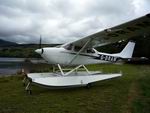
Loch Earn |
C172 amphibian |
Glassy water on Loch Earn |
Prestwick (EGPK) |
General
Avialble to UK licence holders only
Flight Instructors (FI) wishing to give instruction in SEP(sea) shall meet the requirements of FCL.915(b)
FCL.915(b)
(b) Additional requirements for instructors providing flight instruction in aircraft
Applicants for the issue of or holders of an instructor certificate with privileges to conduct flight instruction in an aircraft shall:
(1) for licence training, hold at least the licence or, in the case of point FCL.900(c), the equivalent licence, for which flight instruction is to be given;
(2) for a rating training, hold the relevant rating or, in the case of point FCL.900(c), the equivalent rating, for which flight instruction is to be given;
(3) except in the case of flight test instructors (FTIs), have:
(i) completed at least 15 hours of flight time as pilots of the class or type of aircraft on which flight instruction is to be given, of which a maximum of 7 hours may be in an FSTD representing the class or type of aircraft, if applicable; OR
(ii) passed an assessment of competence for the relevant category of instructor on that class or type of aircraft; and
(4) be entitled to act as PIC in the aircraft during such flight instruction
Notes:
1. Point (2) and (4) above means the FI must hold a SEP(sea) class rating that has not expired
2. Point (3)(i) and 3(ii) above means the FI must have 15 hours of flight time in a SEP(sea) OR pass an assessment of competence in a SEP(sea) with an FIE qualified to examine in the SEP(sea)
Application
The FI shall apply using the online form SRG2159 showing logbook and licence evidence of meeting the requirements of FCL.915(b)
Assessment of Competence
The assessment of competence schedule is given below
Section 1 Theoretical Knowledge Oral (See note 1)
#Long briefing / lesson title
#Air law
Aircraft general knowledge
Flight performance and planning
Human performance and limitations
Meteorology
Navigation
Operational procedures
Principles of flight
Training administration
Section 2 Pre-Flight Briefing
Visual presentation and content
Technical accuracy
Clarity of explanation
Clarity of speech
Instructional technique including TEM/CRM
Use of models and aids
Student participation
Section 3 Flight
Arrangement of demonstration
Synchronisation of speech with demonstration
Assessment and correction of student faults
Aircraft handling
Instructional technique
General airmanship and safety
Positioning and use of airspace
Risk assessment including TEM/CRM
Section 4 Mandatory Exercises and other Exercises at Examiner's discretion
Spin avoidance (SE aeroplane)
Safety module
(See note 2)
Take-off and climb, engine failure after take-off (SE aeroplane)
Approach, landing, missed approach
Forced landing without power (SE aeroplane)
Additional exercises title and number
Section 5 ME (Aeroplane) Exercises (See note 3)
Engine failure (simulated) after take-off or on go-around
Asymmetric approach and go around
Asymmetric approach and landing
Section 6 Instrument Exercises
Basic instrument flight
Applied instrument flight
Instrument approach
Limited panel and unusual attitudes
Section 7 Post-Flight De-Briefing
Visual presentation and content
Technical accuracy
Clarity of explanation
Clarity of speech
Instructional technique and facilitation
Use of models and aids
Student participation
Notes:
1. This section is divided into two parts:
# The applicant is required to give a lesson under test conditions to other student(s), one of whom will be the examiner. The test lesson is to be selected from items of section 1. The amount of time for preparation of the test lesson is agreed upon beforehand with the examiner. Appropriate literature may be used by the applicant. The test lesson should not exceed 45 minutes
# The applicant is tested orally by the examiner for knowledge of items of section 1 and the core instructor competencies as given in the instructor course
2. The safety module is to comprise one or more exercise(s) from the following topics: weather appreciation, flight in poor visibility, calculation and appreciation of safety altitude, stall/spin awareness and navigation techniques
3. This section comprises additional exercises covering ME instructional privileges and is completed in a ME aircraft or FFS or FNPT II simulating a ME aircraft. This section, if applicable, is done in addition to sections 2, 3, 4, 6 and 7
References
The Commercial Pilot's Study Manual Series By Mike Burton (Volume 1 and 2 only)
AP3456 Royal Air Force Manual Flying (volume 1 only - Principles of Flight)
UK CAA Standards Document 14
CAP 804
Part FCL including AMC and GM
Instructor Manual (Part FCL edition)
Notes of a Seaplane Instructor Burke Mees
Flying a Floatplane C Marin Faure
How to Fly Floats J J Frey
Seaplane Operations Dale DeRemer / Cesare Baj
International Regulations for Preventing of Collisions at Sea Royal Yachting Association
Symbols And Abbreviations used on Admiralty Charts - Chart 5011
International Association of Lighthouse Authorities (IALA) Maritime Buoyage System - ANP735
Rules of the Road John Mellor
A Seaman's Guide to the Rules of the Road by Morgan Technical
Nautical Almanac
ICAO Annex 2 Rules of the Air Chapter 3 Paragraph 3.2.6 Water Operations
ICAO Annex 6 Parts 1 and 2 Operations of Aircraft Chapter 6, Appendix to Chapter 6 Lights to be Dispalyed by Aircraft
Privileges (FI SE Seaplane)
To conduct flight instruction for the issue, revalidation or renewal of:
(a) a PPL(A) and LAPL(A) in a seaplane
(b) class and type ratings for single-pilot, single-engine seaplane, except for single-pilot high performance complex seaplanes, when the privileges sought by the applicant are to fly in single-pilot operations
Validity
36 months
Revalidation (FCL.940.FI, AMC1 FCL.940.FI)
Complete 2 of the following requirements:
(a) complete 50 hours of flight instruction during the period of validity. If the privileges to instruct for the IR are to be revalidated, 10 of these hours shall be flight instruction for an IR, and shall have been completed within the last 12 months preceding the expiry of the FI certificate (see notes 2, 3)
(b) completed instructor refresher training as an FI at an ATO or at the NAA during the period of validity
(c) pass an assessment of competence within 12 months preceding FI certificate expiry (see notes 1, 4, 5)
Notes:
1. An assessment of competence must be included as part of the revalidation requirements at every alternate revalidation
2. The 10 hours instrument instruction is not required if you teach only for the UK IMC rating / IR (Restricted)
3. The 10 hours IR instruction can be completed in either a SE or ME aeroplane if both SE and ME instructional privileges are held
4. In the UK holders of both SE and ME instructional privileges may complete a single flight in either a SE or ME aeroplane and the other privilege will be examined by oral questions during section 1 of the assessment of competence. This may not be the case in EASA
5. In EASA the assessment of competence must be the last item of the revalidation process in accordance with FCL.1030. In the UK this is not the case
6. When an assessment of competence is required for revalidation of an FI certificate, an applicant who fails to achieve a pass in the assessment before the expiry date of the FI certificate shall not exercise the privileges of that certificate until the assessment has successfully been completed
7. Hours flown as an examiner during skill tests or proficiency checks shall be credited in full towards revalidation requirements for all instructor certificates held
Renewal (FCL.940.FI, AMC1 FCL.940.FI)
Complete both of the following requirements within 12 months preceding FI certificate renewal:
(a) completed instructor refresher training as an FI at an ATO or at the National Aviation Authority
(b) pass an assessment of competence (see notes 1, 2)
Notes:
1. In the UK holders of both SE and ME instructional privileges may complete a single flight in either a SE or ME aeroplane and the other privilege will be examined by oral questions during section 1 of the assessment of competence. This may not be the case in EASA
2. In EASA the assessment of competence must be the last item of the revalidation process in accordance with FCL.1030. In the UK this is not the case
FCL.1030
When conducting skill tests, proficiency checks and assessments of competence, examiners shall:
(i) ensure that communication with the applicant can be established without language barriers
(ii) verify that the applicant complies with all the qualification, training and experience requirements in Part FCL for the issue, revalidation or renewal of the licence, rating or certificate for which the skill test, proficiency check or assessment of competence is taken
(iii) make the applicant aware of the consequences of providing incomplete, inaccurate or false information related to their training and flight experience