


 |
 |
 |
Learn to fly an ILS down to 500 ft AAL safely |
Learn unusual attitude recoveries on full and limited panel |
Flight training backed up with theoretical knowledge instruction |
General
The IMC Rating is a UK national rating and is designed as a 'get you out of trouble' qualification and not as a replacement for the IR
The IMC Rating may not be endorsed onto a non-UK CAA issued licence
Prior to 1 October 2025 in the UK the IMC Rating was called the IR(Restricted) and had all the privileges and restrictions of a IMC Rating in both Part 21 or non-Part 21 aircraft
The privileges of the IMC Rating are confined to UK airspace only unless the National Aviation Authority of the Country it is to be used in has given permission
The IMC Rating can not be endorsed on a LAPL(A) as the LAPL(A) is a VFR only licence and the LAPL(A) is no longer issued by the UK from 1 October 2025
The IMC Rating can be endorsed on to an NPPL(A), Part FCL licence (PPL(A), CPL(A) or ATPL(A)) and a United Kingdom PPL(A). Holders of a United Kingdom CPL(A) or ATPL(A) already contain the privileges of the IMC Rating which never need to be revalidated/renewed
Pilots holding, or applying for the issue of an IMC Rating, are strongly advised to obtain training before flying RNP approaches in UK airspace
Experience Requirements
An applicant for an IMC Rating must have:
(a) 25 hours total experience as pilot of aeroplanes following PPL(A) issue and which may include the training for the UK IMC rating
(b) 10 hours as PIC of aeroplanes to include 5 hours as PIC of aeroplanes on cross country flights
(c) a UK issued Flight Radiotelephony Operators Licence (FRTOL)
Flight Training
Completed at least 15 hours dual instrument flying training. Up to 5 hours of this training may be completed in a UK FSTD e.g. BITD, FNPT I/II, up to 2 hours of which may be in other FSTDs recognised by the UK CAA
At least 10 of the 15 hours must be flown by sole reference to instruments
Where an applicant wishes to be tested for the IMC Rating on a SP ME aeroplane the flying training must ensure that when in simulated instrument flight conditions in a ME aeroplane the applicant can maintain stable flight after an engine failure at climb power, then climb at recommended speed and execute the normal range of flight manoeuvres under asymmetric power
The flight training shall cover the following items:
Basic Stage
Full and limited panel flight manoeuvres to include recoveries from unusual attitudes
Partial panel flight manoeuvres
Applied Stage
Pre-flight planning
Departure and en-route
Approach and let-down
Bad weather circuits and landings
Ground Training
A minimum of 20 hours of theoretical knowledge training covering the following subjects:
Physiological Factors
Flight Instruments
Aeronautical Information Service - NOTAMS, UK AIP, AICs
Flight Planning - Meteorology, Altimetry, Terrain clearance, Radio aids, Radar approach procedures
Privileges of the IMC Rating
IMC Rating Theoretical Knowledge Examination
25 multi-choice questions covering the IMC Rating theoretical knowledge. The pass mark is 75%. The examination should be taken before the flight test
The examination is valid for 21 months for the issue of the IMC Rating and 12 months for the conduct of the flight test
IMC Rating Initial Flight Test
Conducted by a Flight Examiner (FE), Instrument Rating Examiner (IRE) or Class Rating Examiner (CRE) holding IMC Rating privileges
The initial flight test may be completed in more than 1 flight but not more than 3 (including any extra flight required to test limited panel items, where applicable) and must be completed in a period of 28 days
If any item in a section is failed, that section is failed, which results in a partial pass. Failure in more than one section will result in a fail and will require the applicant to take the entire flight test again
Further training may be recommended following any failed flight test. There is no limit to the number of flight tests that may be attempted
The flight test comprises of the following sections:
Section A - Full Panel Instrument Flying
Straight and level at given speeds, turns at a given rate and onto given headings, climbing and descending including turns, recovery from unusual attitudes
Section B - Limited Panel Instrument Flying (Failure of Attitude Indicator and DI)
Straight and level flight, climbing and descending, turns onto given headings, recovery from unusual attitudes
Section C - Radio Navigation Aids
Use of radio navigation aids for position-finding using one or more aids to include VOR and ADF/NDB, maintenance of a given track based on a pilot-interpreted aid for 10 minutes
Section D - Let-Down and Approach Procedures
Let-down and approach to minima, missed approach procedure using a pilot-interpreted aid, carry out a recognised instrument approach procedure to minima, thence the appropriate go-around and missed approach procedure
Section E - Bad Weather Circuits
Bad weather circuit following Section D, position the aircraft in the circuit at the direction of the examiner, to carry out a visual bad weather circuit and landing under specified weather conditions
Section F - Flight with Asymmetric Power (ME only) (see note)
Control of the aeroplane and maintenance of a given heading and asymmetric climb speed, following the failure of one engine in the climbing configuration at normal climb power. Identification of the failed engine and the completion of all essential drills and checks. Climbing and level turns in asymmetric flight as directed by the examiner
Note: Throughout Section F the examiner is responsible for navigation and ATC liaison. On resumption of normal flight the examiner will advise the applicant of the aeroplane position
Credits
The holder of a course completion certificate for the Basic Instrument Flying Module may have the total amount of flight training reduced by 10 hours
IMC Rating privileges are contained within a United Kingdom CPL(A) and ATPL(A) (this does not include a JAA or Part FCL licence). There is no requirement to revalidate/renew the IMC Rating privileges for these licences
Holders of the AOPA (UK) Radio Navigation Certificate may have instrument flight training during the Applied Stage reduced by 5 hours
Additional credits are available for ICAO IR holders and the UK Armed Forces
Refer to CAP 804 Part 1, Section 5, Part E and CAP 804 Part 2, Section 5, Part E
Validity
25 months
Revalidation
Pass a revalidation flight test prior to rating expiry (see IMC Rating Revalidation/Renewal Flight Test)
Renewal
Expired by not more than 5 years
Complete the revalidation requirements (see IMC Rating Revalidation/Renewal Flight Test)
Expired by more than 5 years
Complete dual instruction as required to pass a renewal flight test with the same content as the initial flight test
Expired by more than 10 years
Complete dual instruction as required to pass a renewal flight test with the same content as the initial flight test and pass the IMC Rating theoretical knowledge examination
IMC Rating Revalidation/Renewal Flight Test
Conducted by a Flight Examiner (FE), Instrument Rating Examiner (IRE) or Class Rating Examiner (CRE) holding IMC Rating privileges
Revalidation and renewal flight tests may be completed in more than 1 flight but not more than 3 (including any extra flight required to test limited panel items, where applicable) and must be completed in a period of 28 days
If any item in a section is failed, that section is failed, which results in a partial pass. Failure in more than one section will result in a fail and will require the applicant to take the entire flight test again
Further training may be recommended following any failed flight test. There is no limit to the number of flight tests that may be attempted
The revalidation/renewal flight test will comprise Sections B, D and E of the initial flight test. The type of approach aid used must be entered in the candidate’s logbook
A revalidation/renewal flight test which is a first multi-engineflight test must include Section F
The revalidation/renewal flight test need only include 1 instrument approach provided:
(i) The IMC Rating has not expired by more than 5 years
AND
(ii) That there is logbook evidence that, in the period between initial and/or revalidation flight tests, that the candidate has successfully completed a let-down and notified, recognised approach to DH/MDH, a go-around and a missed approach procedure to the satisfaction of an instructor qualified to teach for the IR or IMC Rating and countersigned by that instructor
Privileges
An IMC Rating (Aeroplanes) entitles the holder of the licence to act as pilot in command or co-pilot of an aeroplane flying under IFR except:
(i) in Class A airspace
OR
(ii) when the aeroplane is taking off or landing at any place if the flight visibility below cloud is less than 1,500 metres
The holder of the IMC Rating must not fly as pilot in command or co-pilot of an aeroplane outside the airspace of the UK in circumstances which require compliance with the IFR
Information and FAQs
An information sheet about the IMC Rating can be found here
References
AOPA (UK) IMC Syllabus
CAP 413 Radiotelephony Manual
Air Navigation Order (ANO)
CAP 804
VOR, ADF and RMI by Martin Cass
Ground Studies For Pilots by R B Underdown (Volume 1 only)
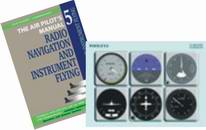
The Air Pilots Manual Volume 5 by Trevor Thom
The IMC Confuser by Neung Sornying
The IMC Rating Questions and Answers Simplifier by Philip Mathews and Jeremy M Pratt